


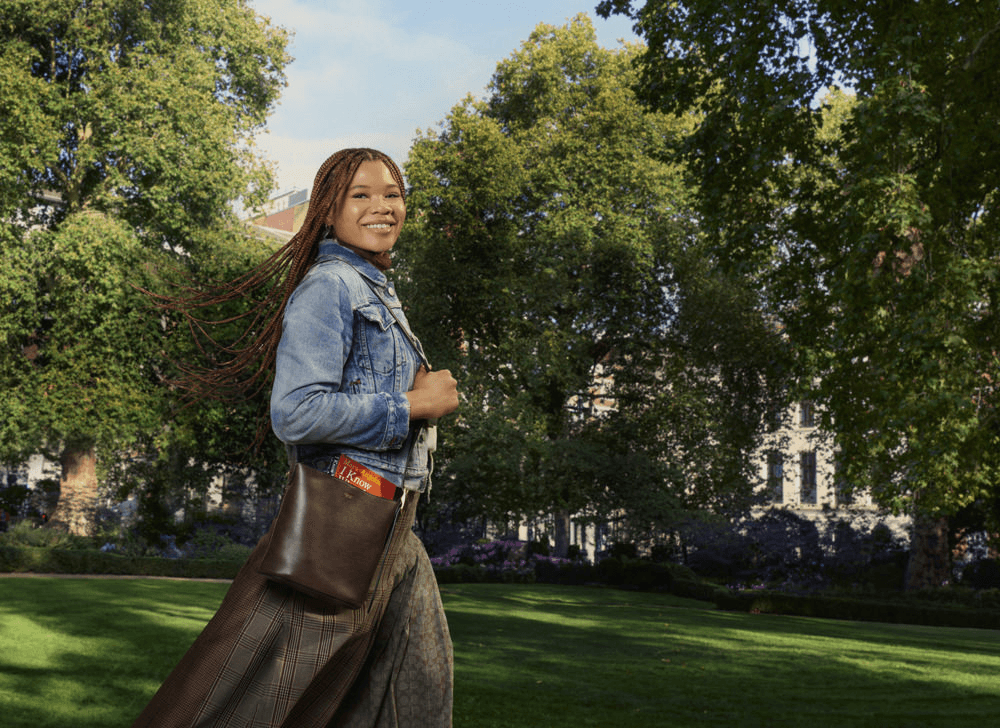
I came across Coach’s new spring campaign this week and it’s been stuck in my head since. The campaign is called “Explore Your Story.” The centrepiece is the Tabby bag, but the interesting bit is what they hung off it: small book-shaped charms, miniature readable books with actual text inside them. Titles like Sense and Sensibility and I Know Why the Caged Bird Sings, made in partnership with Penguin Random House, clipped onto the strap for $95 each.
Sounds like a quirky accessory play. It isn’t. There’s proper strategic thinking underneath it, and there are a few things I wanted to pull apart because I think they’re applicable well beyond fashion.
Coach didn’t design this campaign in a room and then present it to Gen Z for approval. They ran listening sessions with Gen Z communities around the world before the creative took shape. They partnered with Sunnie (a Gen Z book club backed by Reese Witherspoon’s Hello Sunshine) and China Youth Daily. They worked with Penguin Random House in the US and independent publishers across Asia to bring the book titles to life.
I want to be precise here because the press releases call it “co-created with Gen Z,” and I think that’s slightly generous. Coach listened, brought communities into the process early, and let that input inform the campaign. That’s different from handing over the reins entirely. But it’s also miles ahead of what most brands do, which is build the whole thing internally and then test it on a focus group at the end to make sure nobody hates it.
The difference matters because when people feel like something was shaped by them, even partially, they interact with it differently. They’re not just an audience anymore. They’re invested. I’ve seen this work on a much smaller scale too, in my own work. Even letting a customer base vote on something minor, like a colourway or a product name, changes the energy around a launch completely.
There’s been a temptation in the marketing press to frame this as Coach uncovering some hidden insight about Gen Z quietly returning to books. That’s a nice narrative but it’s not really accurate. Reading is visibly trending with younger audiences. BookTok is enormous. NBC ran the headline “Reading is so trendy now that Coach is making book charms.” Coach didn’t discover an underground movement. They spotted a visible cultural moment and figured out how to connect to it in a way that feels personal rather than opportunistic.
A book charm on a bag is a signal. It tells someone what you’re into without you having to explain yourself. That’s a different play from slapping a logo on a trending topic and hoping the association does the heavy lifting, which is what most brands would have done here. “We love books too!” plastered across a social campaign. Coach went further and made the connection physical, personal, something you carry around.
The campaign films do the same thing well. Directed by Marcus Ibanez, shot by Elaine Constantine, featuring Elle Fanning, Storm Reid, Paige Bueckers, SOYEON and others. Each person is shown reading as their world transforms around them. It’s not “buy this bag.” It’s closer to “your story matters, here’s a way to wear that.”
The bit that impressed me most, though, is how consistent the whole thing is across touchpoints. There’s a travelling college campus tour (the “Coach Tabby Tour: Explore Your Story Edition”) running across the US and Asia. There are the publisher partnerships. The films. Community programming where students share their own stories. All of it tells the same story, and the message doesn’t drift depending on the channel.
That sounds obvious but almost nobody pulls it off. What normally happens is the campaign starts with a strong idea and then the execution fragments. The social team interprets the brief one way, the retail team interprets it another, the PR angle drifts slightly, and by the time the customer encounters it across three or four touchpoints, the thread’s gone. It just feels like a collection of loosely related stuff rather than one coherent thing. I’ve been guilty of this myself. You get so deep into individual channel execution that you lose sight of whether the whole thing still hangs together when you zoom out.
Coach held it together across a global rollout with six celebrity ambassadors and campus activations in multiple countries. That takes discipline from every team and agency involved, and you can feel the result. Everything points in the same direction.
If you take one thing from this campaign, it’s probably that:
Write your idea in one sentence before you brief anyone, and then hold every piece of execution accountable to that sentence. If something doesn’t serve it, rework it or bin it.
What I keep coming back to is how uncontrived it all feels. Coach has serious money behind it and this could easily have been an overproduced, try-hard thing designed to signal relevance to a younger audience. Instead it feels like someone actually asked what would mean something to the people they’re trying to reach, rather than what the brand wants to say about itself.
That question is free. So why do so few brands bother asking it?
Thanks for reading,
Jack Willoughby